
CLIFF EFFECT
The Cliff Effect is one of the biggest and most persistent barriers trapping families in poverty and preventing upward mobility. It happens when a small pay raise triggers a sudden, disproportionate loss of government assistance—leaving families worse off than before. Losing access to essential benefits like food, housing, healthcare, or childcare can make it impossible to get ahead, forcing people to choose between progress and stability.
LEARN MORE
Benefits Cliff in Our Community
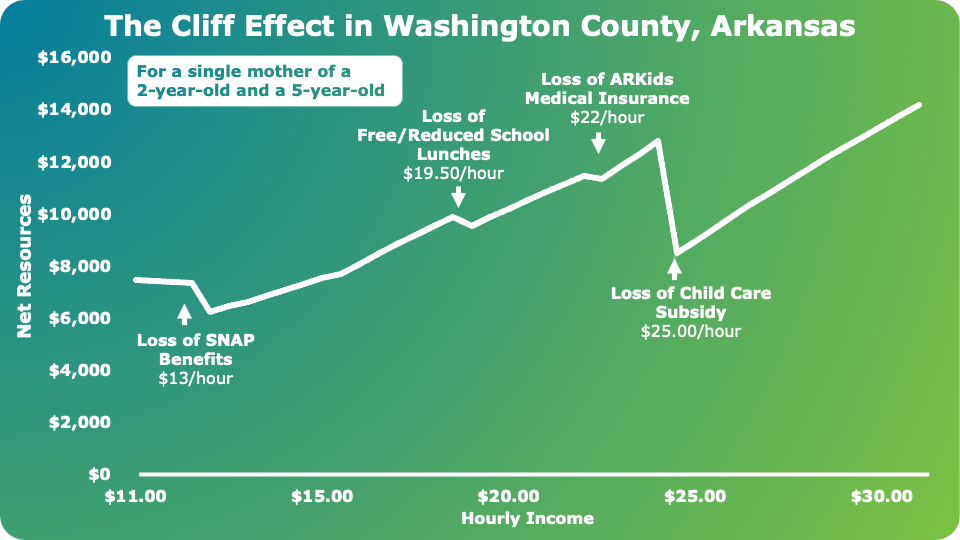
The data in this chart is based on a scenario of a single mother with two young children living in Washington County, Arkansas. It was created using data from the CLIFF Policy Database Tool.
- SNAP (food assistance) – when this mother increases her pay past $13/hr, she loses access to food assistance benefits.
- Free/Reduced Lunches – when this mother increases her pay past $19.50/hr, she will have to start paying full price for her child’s school meals.
- Loss of child care subsidy – when this mother increases her pay to $25/hr, the $5,991 she received every year for child care drops to $0, a major cliff.
- Housing – In contrast, there is no housing cliff shown on the chart even though her housing benefit decreases to $0 around $16/hr. This is because instead of dropping off abruptly once she reaches an income threshold, section 8 housing is based on a percentage of income and gradually decreases as income increases.